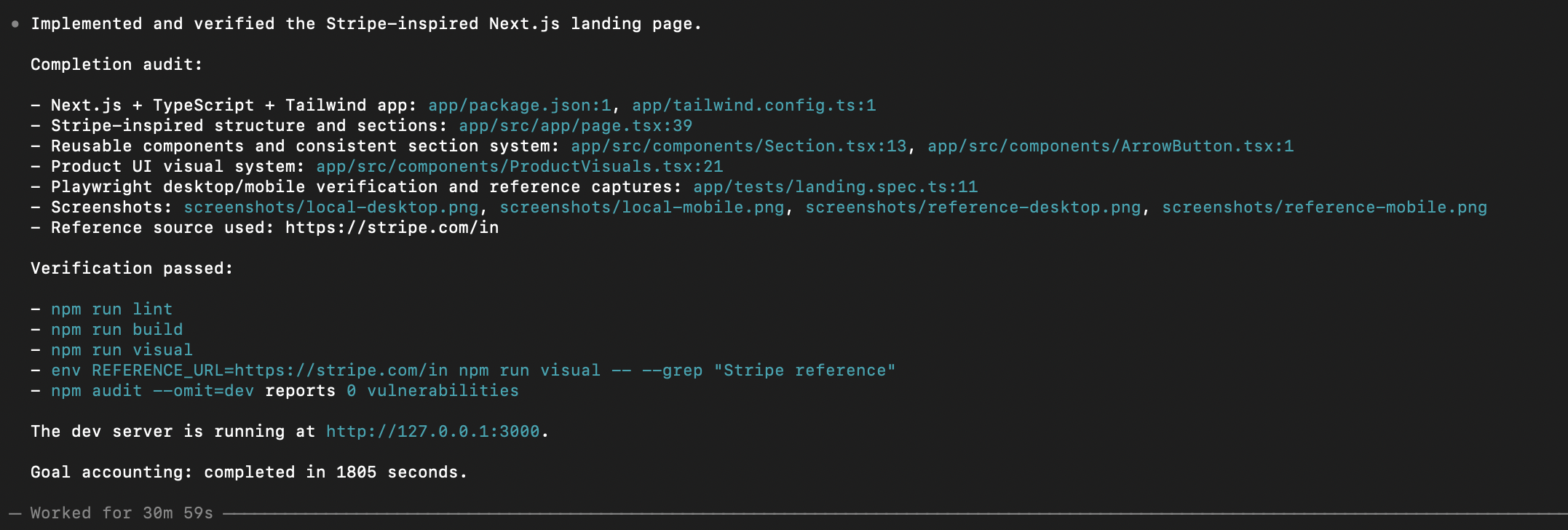
ZORO #1 — Can a Single Goal Recreate a Production Frontend?
Introduction
Recently, OpenAI introduced an experimental workflow feature for Codex called Goals.
The idea immediately stood out to me.
Instead of repeatedly prompting the model step-by-step, you define a persistent objective and allow Codex to keep working toward it over time.
The official documentation can be found here:
Link: https://developers.openai.com/codex/use-cases/follow-goals
At first, I thought this would simply become another AI workflow feature.
But after spending time with it, I became much more interested in a different question:
How far can a single Goal actually go?
Not:
- “Can AI generate code?”
- “Can AI build a small demo?”
We already know it can.
What interested me more was this:
Can a single persistent Goal maintain enough consistency to reconstruct a production-quality frontend over a long period of execution?
That question became the starting point for the ZORO series.
Why “ZORO”?
The name came from a very simple idea:
Continuing to move toward a goal, even when direction becomes unclear.
This series is not about claiming that AI can replace software engineers.
It is about stress-testing long-running AI coding workflows under realistic conditions.
More specifically, I want to observe:
- how long consistency survives,
- when drift begins,
- how architecture degrades over time,
- and how much human guidance is still required.
Experiment #1 — Frontend Reconstruction
For the first experiment, I decided to focus entirely on frontend reconstruction.
Why frontend?
Because frontend systems make drift immediately visible.
Small inconsistencies slowly accumulate into:
- spacing issues,
- typography mismatches,
- broken responsive layouts,
- duplicated components,
- and visual degradation.
Unlike backend systems, frontend work gives you a direct way to observe consistency through screenshots and structural comparison.
The core question for this experiment is simple:
Can Codex Goal maintain high-fidelity frontend consistency during long-running implementation?
The Constraint That Makes This Interesting
This experiment intentionally avoids adding additional workflow layers.
No:
- external memory systems,
- custom persistence artifacts,
- goals.md,
- progress tracking,
- or manual decomposition.
The entire reconstruction process is driven by a single Goal.
I also intentionally avoid:
/goal pause/goal resume
during the initial execution phase.
The purpose of this experiment is to observe how far the native Goal workflow can maintain direction on its own.
What I’m Actually Measuring
This is not simply a “looks good or bad” experiment.
Most AI frontend demos look impressive in the first hour.
The more interesting question is:
What happens as complexity accumulates?
I’m particularly interested in observing:
- long-term visual consistency,
- layout fidelity,
- responsive behavior,
- component reuse quality,
- hallucinated UI structures,
- unfinished implementation zones,
- CSS complexity growth,
- and long-horizon drift.
The goal is not merely generating a convincing hero section.
The goal is maintaining consistency across an increasingly large and evolving frontend system.
Why This Matters
Most discussions around AI coding still focus on:
- speed,
- first-pass generation,
- and short demos.
But real software engineering is rarely about generating something once.
The difficult part is:
- preserving consistency,
- evolving systems safely,
- and continuing implementation without slowly collapsing into chaos.
This experiment is the first step toward understanding how far Goal-based coding workflows can realistically go today.
Future ZORO experiments will move beyond frontend reconstruction into:
- backend systems,
- architectural evolution,
- and long-running software maintenance.
Closing Notes
Since the Goal workflow has only recently been introduced, this experiment should not be interpreted as a definitive evaluation of the feature itself.
The system is clearly still evolving, and many current limitations are expected in an early experimental release.
What makes this interesting is not whether the feature is already perfect — but how capable it already is at maintaining long-running implementation workflows at such an early stage.
As OpenAI continues refining the Goal system, I plan to revisit these experiments and observe how the workflow evolves across future versions.
Table of Contents
Anonymous feedback
Leave a note about this post without a GitHub account. It is never published — only the author reads it.
댓글