Devlog · Add-on Doctor · 9 min read
Checking Telecom Value-Added Services
A development note for a service that authenticates a phone number and checks telecom value-added services attached to that number
Idea
This idea came to me while using a Korean service called “Find My Insurance.” With only a resident registration number, phone number, and name, it lets users view all insurance products they are enrolled in. I wondered whether a similar service could show all telecom value-added services a user has subscribed to.
For example, if I use SKT but do not know which add-on services I have, I wanted to build a web service where I could enter only my name and phone number and see all subscribed SKT add-ons at once.
Of course, users can log in to T-world and check subscribed services there. I do that too. Still, I thought it would be useful if checking add-ons could be simpler than opening T-world.
I looked into whether lookup with only a name and phone number is possible, and it is not. Identity verification is required. So I checked the Korean telecom MyData standard API and found that there are telecom value-added service lookup APIs by API code. If I use those APIs, I should be able to build a service that verifies a user through their phone number and then retrieves the telecom add-on services attached to that number.
Is it enough to only fetch and display the data? That would feel a little incomplete. I want to add RAG + chatbot features, so users can ask questions based on their subscribed services. If I also retrieve plan information and recommend better options, the service could become fairly useful.
Because each of the three major carriers has different add-on services, integrating SKT, KT, and LG U+ APIs will be annoying. To build a RAG feature for add-on services, I will also need data collection and preprocessing for the service descriptions.
If traffic spikes because many users arrive at once, I should also consider a serverless architecture. Platforms such as AWS Lambda or GCP Cloud Functions scale automatically with traffic, which should help provide stable service.
For now, I will start by using the Korean telecom MyData standard API to verify a phone number and retrieve the carrier’s add-on services for that number. If that works well, I will add cancellation support and detailed explanations later.
Initial Development Plan
The introduction became long, but in short, the goal is to build a service that verifies a user with a phone number, then retrieves and recommends telecom value-added services for that number.
| Category | Tech | Reason |
|---|---|---|
| Languages | TypeScript & Python | TypeScript for type safety across the Web/API surface, Python for complex LangGraph-based AI orchestration. |
| Frontend | Next.js 15+ (App Router) | Use Server Actions and ISR on static telecom plan pages for strong performance. |
| Backend & Auth | Supabase | A BaaS that provides Postgres, Auth, and RLS together, protecting sensitive MyData records with minimal setup. |
| Vector Database | pgvector (Supabase) | Enables RAG over 900+ services inside existing Postgres, avoiding a separate vector DB. |
| AI Orchestration | LangGraph | State-based multi-step reasoning for usage log analysis and calculation of a “waste index” across hundreds of combinations. |
| LLM & SDK | sLLM / GPT-4o mini | Build an sLLM and route extra tasks to GPT-4o mini through the Vercel AI SDK. |
| Infrastructure | Vercel (Edge Functions) | Global serverless execution with near 200-500ms cold starts and strong scaling during traffic spikes. |
| Caching & Scaling | Upstash (Redis) | Global rate limiting and prompt caching to prevent runaway LLM costs. |
| AI Observability | Langfuse | Essential for tracking per-user LLM costs, tracing agent decision steps, and debugging recommendation reasons. |
| System Monitoring | Sentry | Automated error tracking for serverless functions and frontend crashes, useful for solo operation. |
| Development Method | GitHub Spec Kit | Spec-driven development to keep architecture goals and implementation consistent. |
| Data & Simulation | Mockoon & SmartChoice API | Mockoon for simulating 2026 MyData standard APIs, telecom-001/003, and SmartChoice API for real-time plan data. |
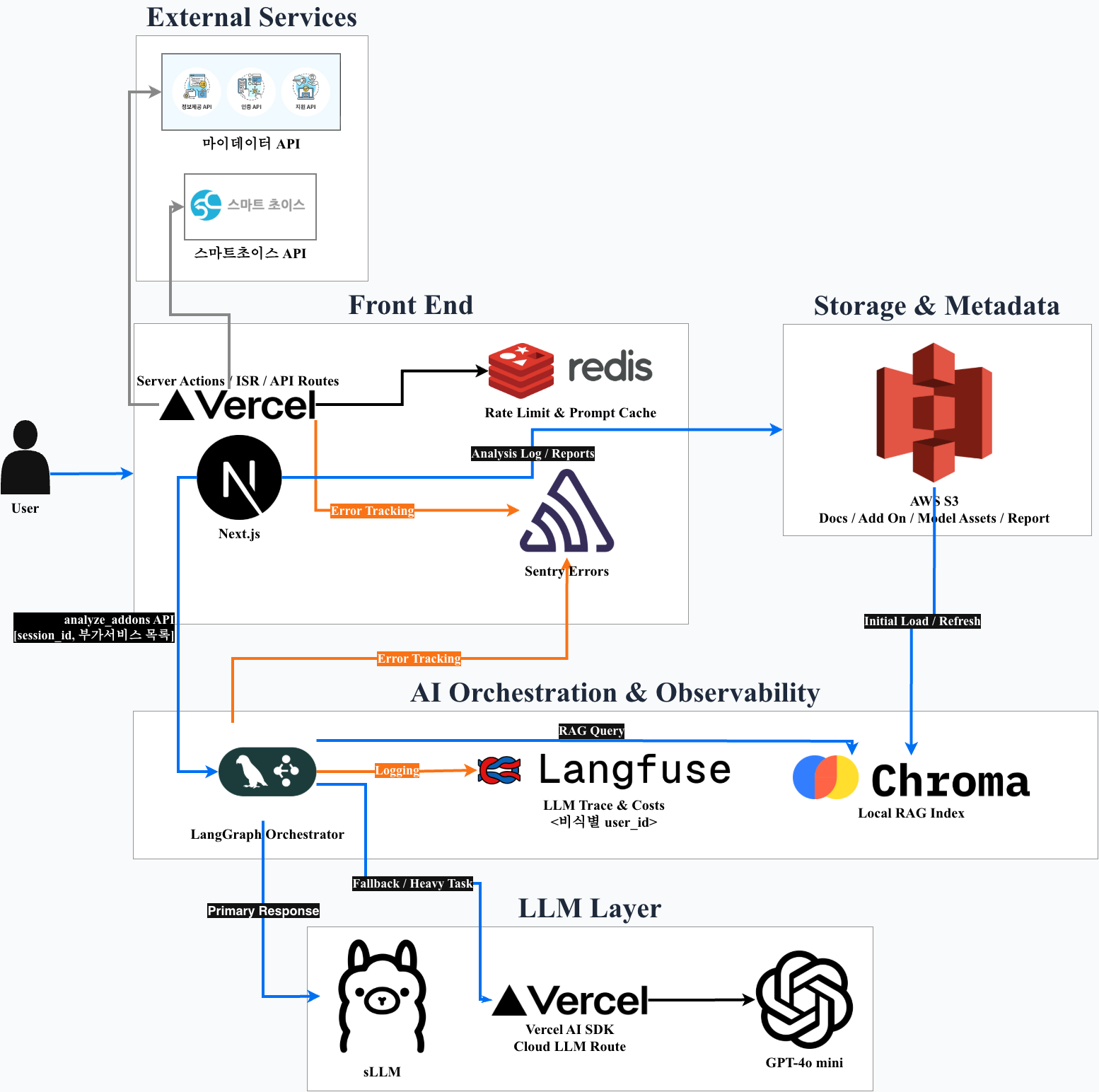
Architecture Diagram
<The following section was written with AI assistance.>
Add-on Doctor v1 Architecture Overview
- Personal information security: Keep raw MyData only in restricted storage, and pass only de-identified, summarized data to the LLM/RAG layer.
- sLLM first, cloud LLM as backup: The main reasoning path uses a self-hosted sLLM, while only complex requests fall back to commercial LLMs. (Otherwise the cost may be too high. In an actual service, this feature may need to be blocked or charged to users.)
- Operational efficiency: Use S3 + local vector storage such as Chroma + a serverless frontend to minimize operational complexity.
Front End: Vercel + Next.js + Redis
- The frontend is deployed to Vercel using Next.js (App Router).
Features:
- Collect user input: carrier selection, add-on list lookup request, analysis button, and so on.
- API Routes / Server Actions:
- Trigger telecom MyData API calls
- Trigger SmartChoice API calls
- Trigger LangGraph analysis API calls (
/api/analyze_addons)
This design does not use login.
For each request, the app creates a session_id, performs a one-time analysis for that session, and immediately shows the result.
The UI should feel like the simple identity verification flows we commonly use. After pulling carrier-specific data and displaying it, the app should only run extra features when the user presses the analysis button or opens the chatbot.
Upstash Redis (Rate Limit & Prompt Cache)
- Use serverless Redis close to the edge for two purposes.
- Rate Limit: Limit analysis requests by IP or
session_idto prevent LLM cost spikes. - Prompt Cache:
- If the same add-on combination and plan are analyzed again, return the cached result without calling the LLM again.
- Rate Limit: Limit analysis requests by IP or
Storage & Metadata: AWS S3
S3 acts as the service’s source data store.
- Data to store:
- Add-on descriptions, plan guides, and policy documents from the three telecom carriers, in formats such as HTML, Markdown, and JSON
- Add-on master table with service name, category, monthly fee, carrier, and so on
- Model-related resources, such as prompt templates and domain rule definitions
- Optional analysis report snapshots, such as
reports/{session_id}.json
I will decide during development whether it is really worth storing this much.
External Services: MyData API + SmartChoice API
Telecom MyData API
- With user consent, use telecom-001/003 and related MyData standard APIs to retrieve:
- Subscription information, such as carrier, plan name, contract/combined products
- Billing history, such as monthly add-on service line items and amounts
- Store this data only by
session_idin S3 or internal storage, and pass only de-identified summaries to the LLM side.
SmartChoice API
- Use the plan and add-on recommendation open API operated by the Korea Telecommunications Operators Association (KTOA).
- Role:
- Based on the current plan and usage pattern, retrieve public-portal-style plan recommendation results.
- Cross-check recommendations generated by the sLLM or supplement the list of alternative plan candidates.
AI Orchestration & Observability: LangGraph + Chroma + Langfuse
LangGraph Orchestrator
LangGraph is used as a Python-based agent/workflow orchestration layer.
- When Next.js sends a request to
/api/analyze_addons, it passes[session_id, summarized subscription information/billing history]to LangGraph. - LangGraph analyzes the request in three steps.
- Preprocessing & de-identification
- Extract only the necessary fields from raw telecom-001/003 data and convert them into a summarized structure.
Example:{carrier, plan_name, addon_list[], monthly_addon_total} - Remove identifiers such as name, phone number, and resident registration number from LLM/RAG inputs.
- Extract only the necessary fields from raw telecom-001/003 data and convert them into a summarized structure.
- RAG + rule-based judgment
- Query Chroma to retrieve add-on descriptions, policies, and alternative options.
- Also perform simple rule-based checks, such as whether a paid add-on overlaps with a plan’s base benefits.
- LLM call
- Give context to the sLLM and ask it to generate “cancel / keep / conditionally keep + reason + expected savings.”
- If needed, fall back to a cloud LLM to polish the natural-language report.
- Preprocessing & de-identification
Chroma (Local RAG Index)
- Use Chroma as the RAG index next to the LangGraph process.
- During initialization:
- Load add-on service documents from S3 for the three carriers.
- Generate embeddings and upsert them into a Chroma collection.
- During queries:
- Search top-k documents by service names or keywords such as “Smart Call Keeper,” “V Coloring,” and “PASS rent deposit safety care,” then use them as LLM context.
Langfuse (LLM Trace & Costs)
- Record all LLM calls and chain steps in Langfuse.
- Group traces by
session_idor de-identifieduser_id. - Monitor token usage, cost, and latency.
- Group traces by
- This information is used for:
- Detecting cost spikes
- Tuning prompts and chains
- Explaining why a recommendation was produced, for debugging and explainability
LLM Layer: sLLM + Vercel AI SDK
Local sLLM
- The main reasoning engine is a self-hosted sLLM.
- Korean-friendly models served through vLLM/Ollama can be used, such as K-EXAONE family models, A.X family models, Solar, and similar options.
- Role:
- Receive add-on lists, plans, SmartChoice results, and Chroma context, then generate:
- “cancel / keep / conditionally keep” classification
- Item-level explanations
- Short summary reports
- Receive add-on lists, plans, SmartChoice results, and Chroma context, then generate:
Vercel AI SDK + GPT-4o mini (Fallback)
- For more complex natural-language reports or cases where the sLLM lacks confidence, call commercial LLMs such as GPT-4o mini / Claude through the Vercel AI SDK.
- Define fallback conditions in LangGraph:
- The report needs to be long
- Multilingual explanation is needed
- The internal evaluation score is low
Observability & Error Tracking: Sentry
- Send errors and warnings from Next.js/Vercel, LangGraph, and the sLLM gateway to Sentry.
- Main goals:
- External API failures, such as MyData/SmartChoice
- LLM call exceptions
- Performance degradation and timeouts
- Frontend runtime error monitoring
Personal Information Security
- Raw MyData, such as telecom-001/003 JSON, names, and phone numbers, is stored only in S3/internal storage. The LLM/RAG layer receives only structured summary data.
- Session identification uses
session_id, and a TTL policy can delete MyData snapshots and reports after a certain period. - Langfuse/Sentry should keep only de-identified IDs and metadata, never sensitive raw text.
Closing
Additional logic that came to mind:
- Because of API call limits, show API call logs directly on the screen.
Other than that, I do not have additional implementation ideas at the time of writing. If I think of something while building, I will add it then.
Anonymous feedback
Leave a note about this post without a GitHub account. It is never published — only the author reads it.
Comments